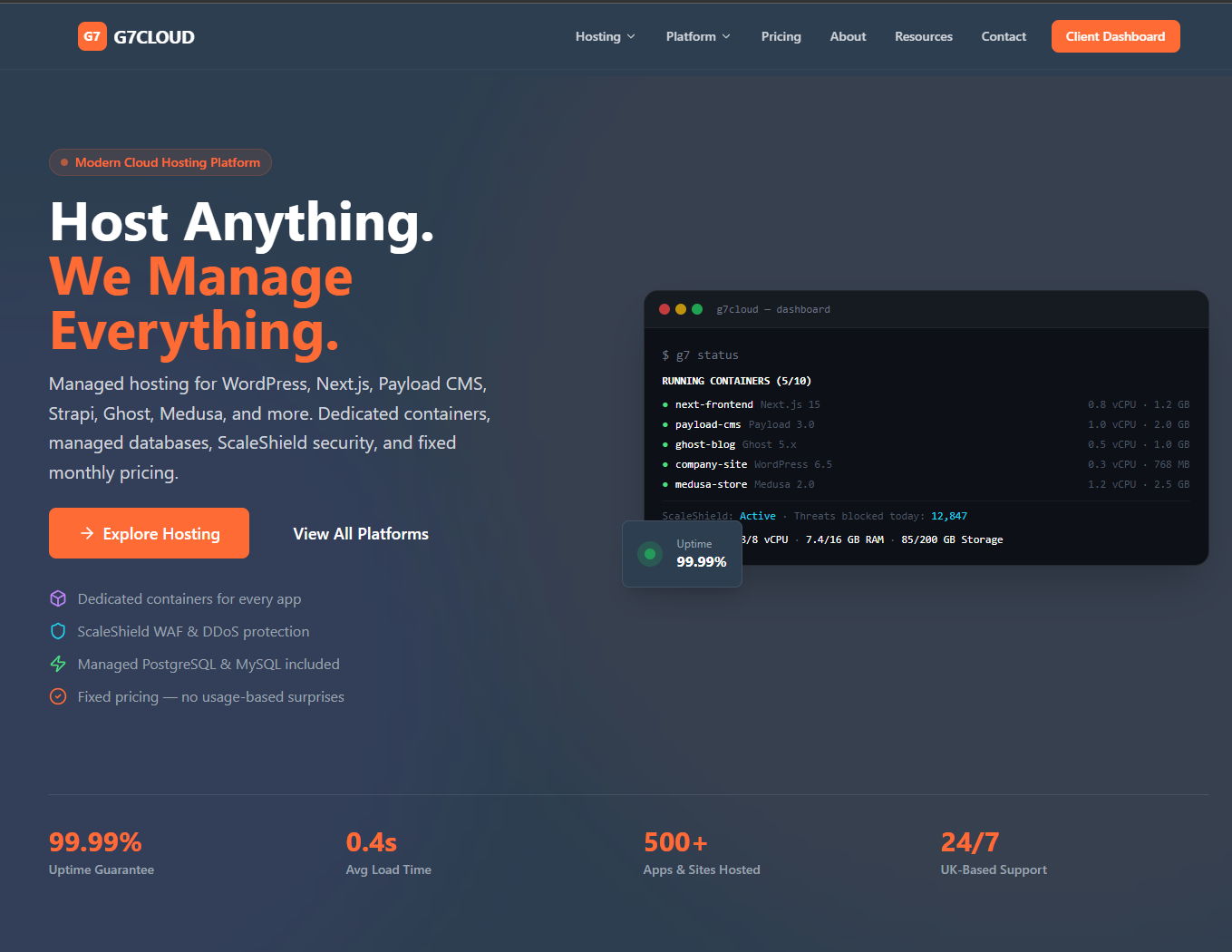
I wanted to offer customers a site they could run independently of their neighbours, without having to look after the server or database themselves.
How it fits together
1VisitorHTTPS
2ScaleShield edgeTLS, cache, WAF, bots
3Traefikrouting from Consul
4Site containerscheduled by Nomad
5Databaseone per site, backed up nightly
Implementation
Scheduling and deploys
Sites run as Docker containers scheduled by Nomad, with Consul for service discovery and Traefik for routing. A git push deploys through a canary, and a version that fails its health check is reverted automatically.
Request handling
Every request passes through ScaleShield, the OpenResty edge I wrote, for TLS, caching, WAF rules and bot defence.
Storage and backups
Managed PostgreSQL and MariaDB, S3-compatible object storage, and nightly backups to a separate vault, with regular test restores.
Mail and DNS in-house
Mail (Postfix, Dovecot, spam and virus filtering) and authoritative DNS (PowerDNS) run on the same scheduler as the sites.
An AI website builder
Customers describe a site in chat and an agent builds it in a sandbox for that site. Every turn is type-checked and built, with up to three automatic repair rounds, before it is saved. Each published version is kept separately so a customer can restore an earlier release.
Managing sites from Claude
An MCP server lets our team run the platform from Claude, through the same API, permission checks and audit log as the dashboard. A generated catalogue covers more than 1,700 API endpoints.
Model selection
The builder and the dashboard assistant have run on several Claude models. They now run on a lower-cost Anthropic-compatible model, with Claude as the fallback.